

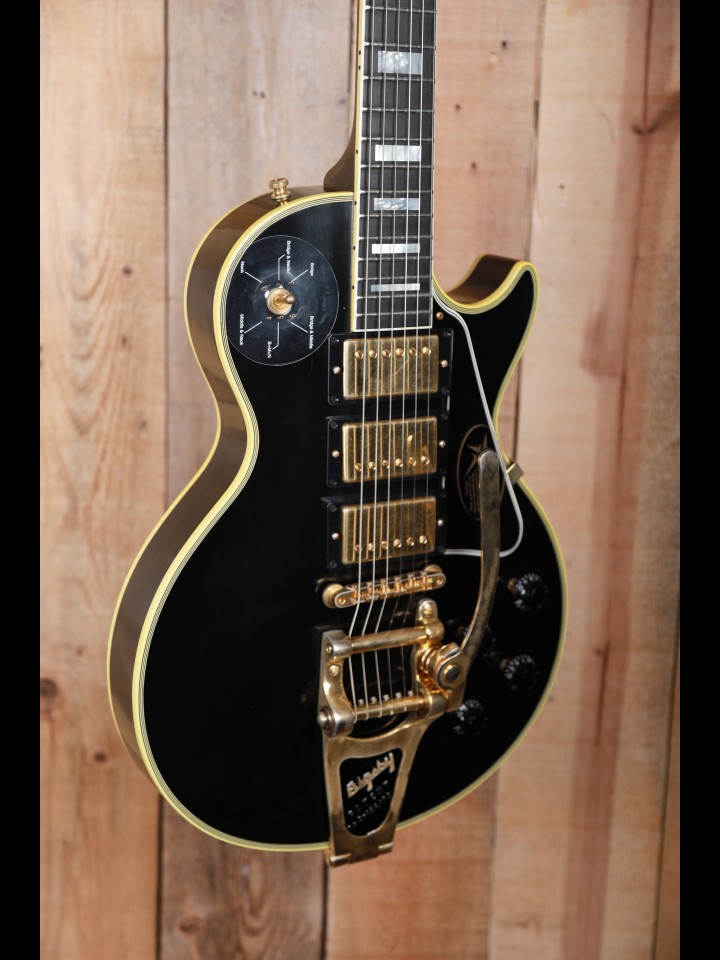
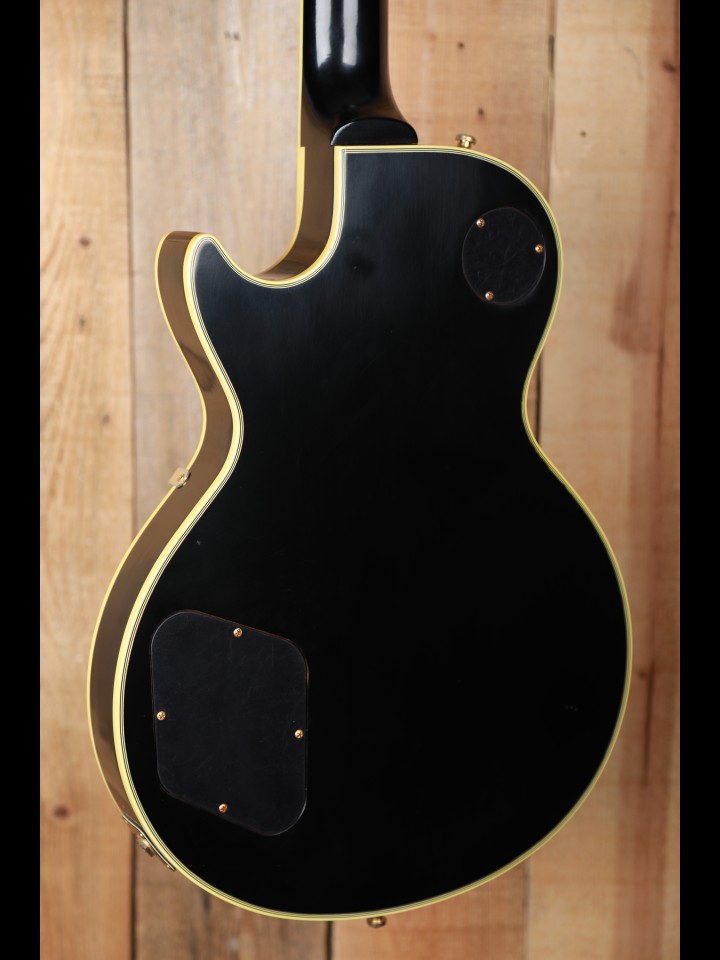
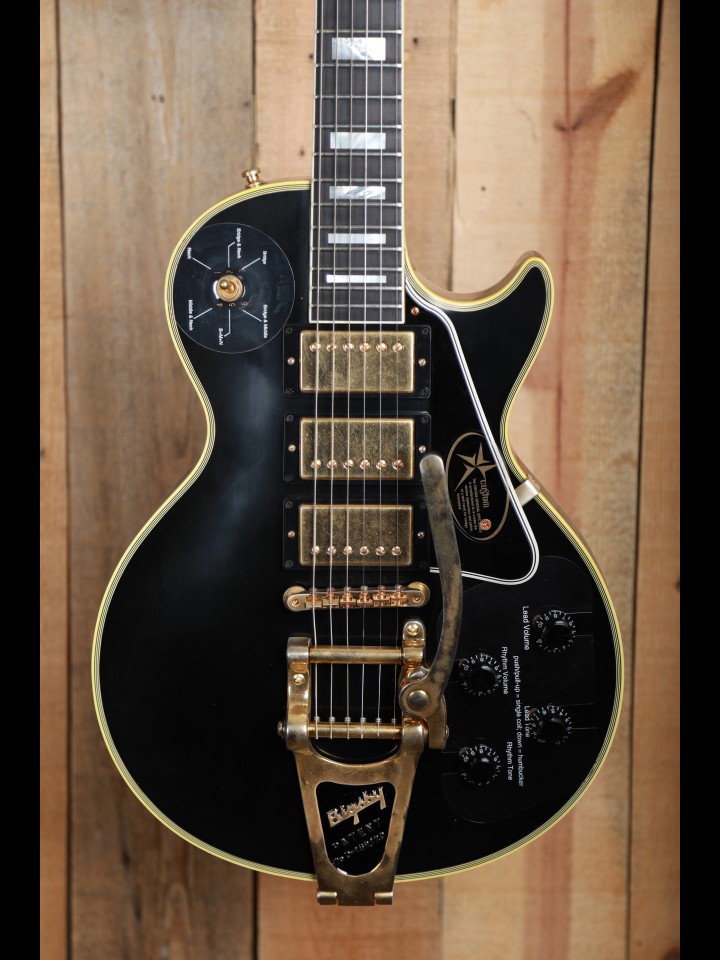
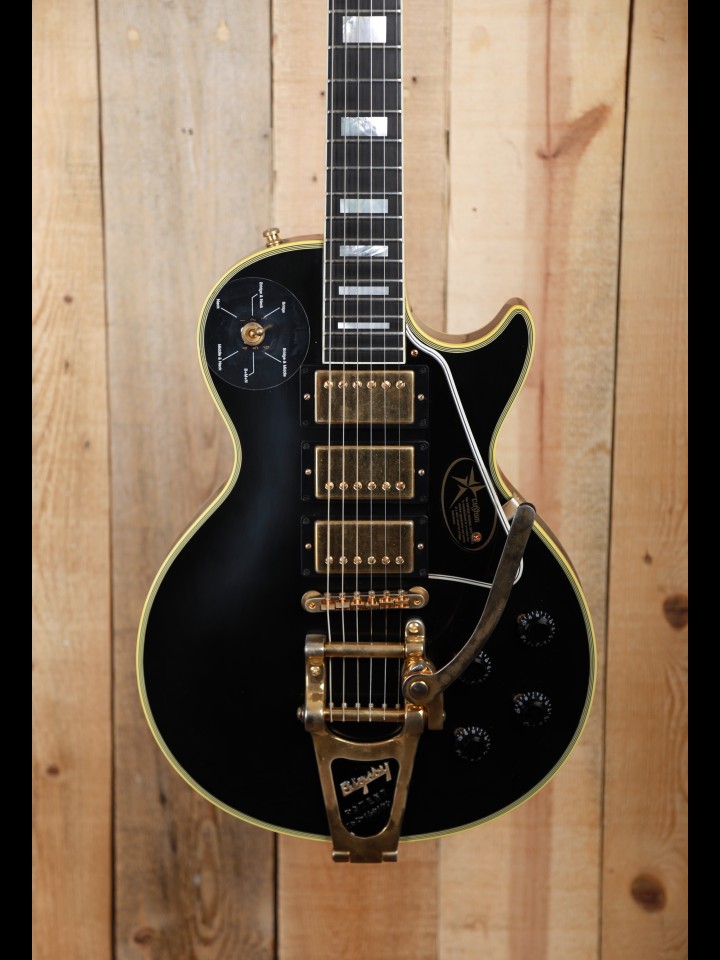

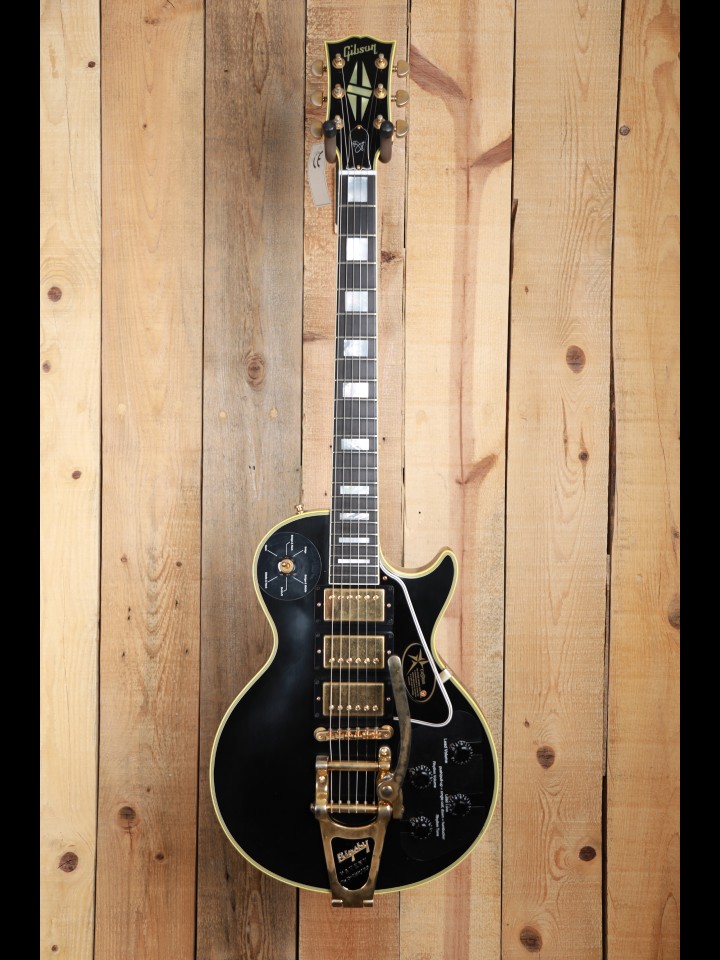
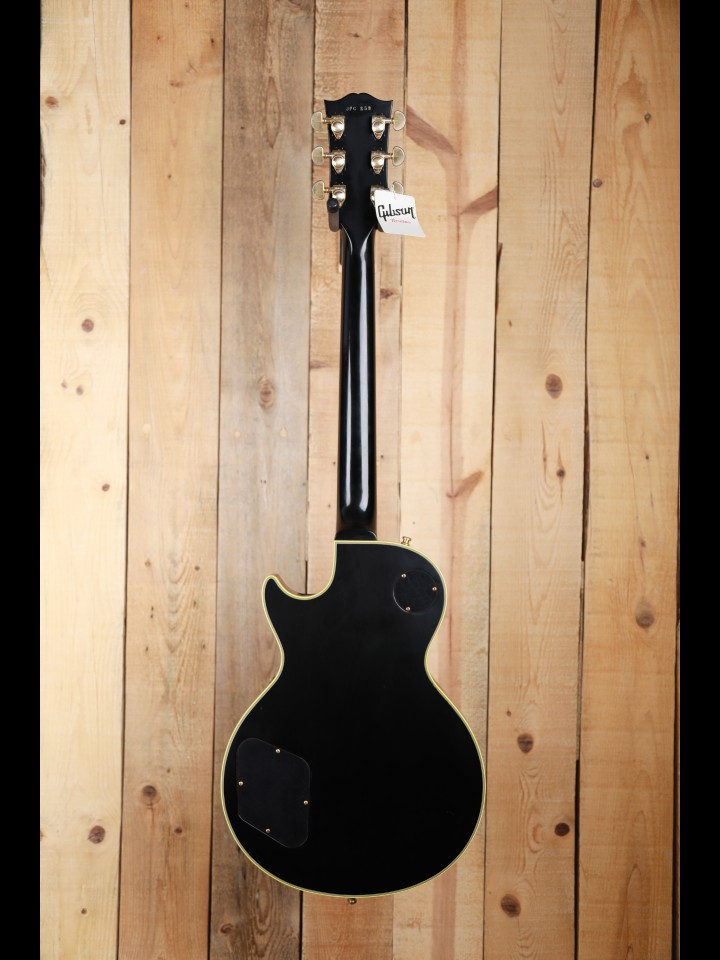
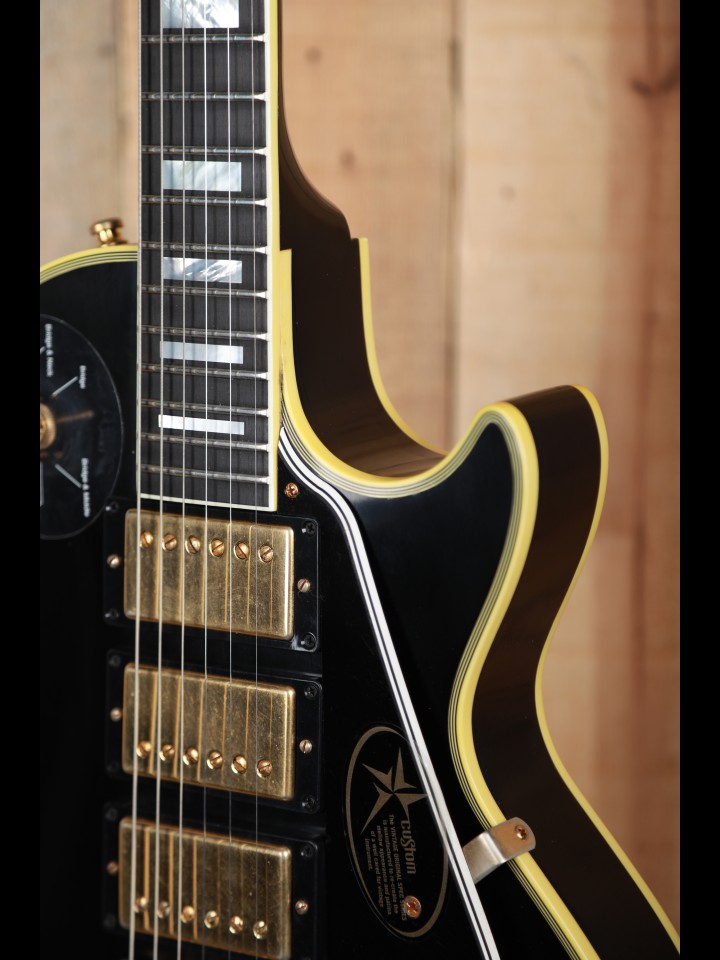
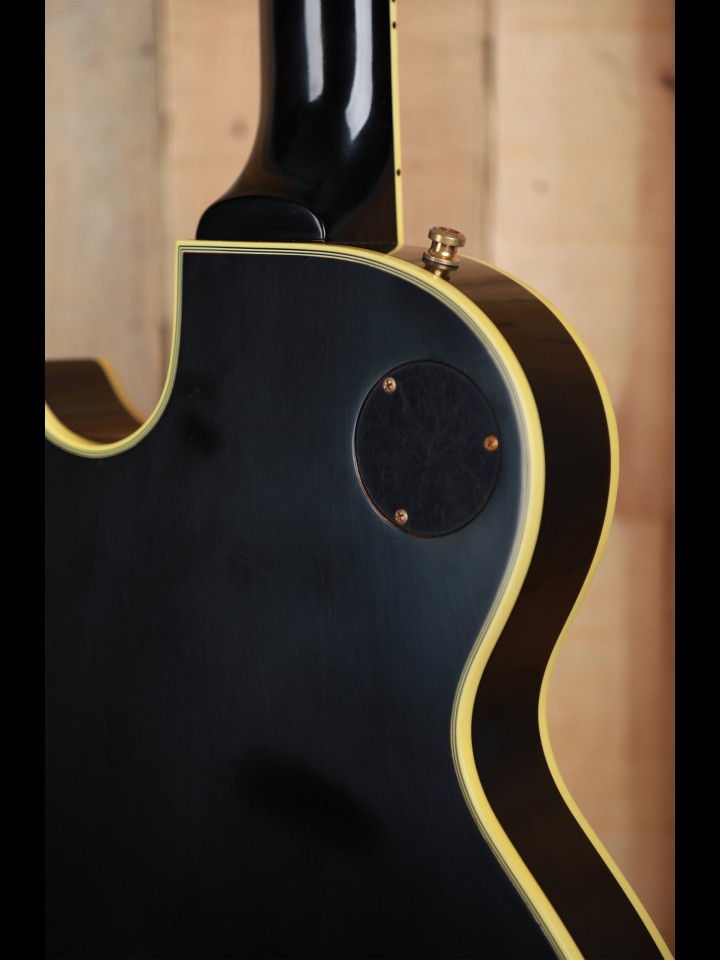
2008 Custom Shop Jimmy Page Les Paul Custom with Bigsby
Disclaimer: At the risk of redundancy, we have reiterated some elements of our copy for the 2009 “Pearly Gates” Les Paul that arrived alongside this 2008 Jimmy Page Custom, as certain aspects of their respective origins and their place in the market are consistent.
As is true of anything collectible, there are various strata within a given market. At the top, there are rare items, there are exceptionally rare items, and then there are singular items. Within the vintage electric guitar market, there are few guitars that can compete with a humbucker-equipped Gibson Les Paul built between 1957 and 1960 in terms of desirability, and therefore price. (As there is exhaustive discourse available elsewhere relating to the topic of Les Pauls of this era, we will not endeavor to expand on it much here!) Within these top collectible model years, the sunburst models (1958-1960) command the greatest premiums, with “flametop” versions (generally 1959 and 1960 model years) typically garnering top dollar over “plaintops” (mostly associated with 1958). Ranked below the sunburst Standards would be the Goldtop Standards made in 1957. Then, finally, the Customs (a.k.a. “Black Beauties” or “Fretless Wonders”), like Jimmy Page’s 1960 example, a truly unique and legendary instrument and the inspiration for this 2008 Custom Shop recreation.
The value of famous singular guitars, like Jimmy Page’s storied Les Paul Custom, is difficult to calculate, particularly as they rarely come to market until their celebrity owner passes on. In terms of money, any celebrity-owned and otherwise top-tier collectible guitar would almost certainly command several million dollars in today’s market. Yet, from a more romantic standpoint, these guitars are actually priceless, given their role in shaping music history. The romance circulating around these instruments is, in large part, fueled by their individual stories, as well as the Red-Violin-esque notion that these guitars will one day hopefully pass to their next stewards (rather than be vaulted or relegated to permanent display). Who will own them? What new music will flow through them? Only time will tell….
The story of Jimmy Page’s 1960 Bigsby-equipped, 3-pickup Black Beauty is about as good of a “Red Violin” narrative as one could imagine. Having achieved a good measure of success as one of Britain’s first call session musicians in the early-mid 1960s, Jimmy could finally afford professional tools. After a period of flirting with a Strat and a Gretsch 6120, the fabled 1960 Les Paul Custom found him, practically leaping off the wall of a local store into his hands. The connection was instantaneous and the guitar quickly became his most prized instrument, appearing on countless major recordings of the time. It was so prized, in fact, that he did not travel with the instrument until its first outing on what would become a fateful Led Zeppelin North American tour in 1970. Towards the end of this tour, Jimmy’s reservations were validated when the instrument went missing as the band crossed the border from the United States into Canada, following their show in Minneapolis. Having formed such a close bond with the guitar, Jimmy understandably spent years searching for it, but the search would prove to be in vain—in those days, any such search had fairly limited scope, with few other ongoing options than to place want ads and hope for the best.
Then, more than twenty years later, the guitar surfaced for the first time at a Minneapolis guitar shop. It arrived in the hands of someone who claimed that he had purchased it for $5000 from the widow of an airport employee who had purportedly stolen the guitar and then stashed it until his death. Quite altruistically, the new owner informed the dealer that he merely wished to get the guitar back in the hands of its rightful owner and to otherwise be reimbursed the $5000. Calls were made, and an expert appraiser was sent to authenticate the guitar. Unfortunately, due to some lack of communication with regard to Jimmy’s modifications to the guitar (namely the two additional toggle pickup switches he’d added), as well as the absence of some evaluation methods that we rely on today, the guitar was misidentified. As a result, it was not returned to Jimmy at the time.
Instead, Jimmy’s lost Black Beauty found its way into the hands of another player. An employee at the music store lusted after the guitar, scraped together the funds to buy it, and then went on to use the guitar extensively for more than twenty years, forming his own bond with the instrument. It was not until the guitar suffered a headstock break (following a notorious guitar strap spin stunt) that it was reevaluated with modern technology. Blacklight analysis revealed that the instrument, which had also been converted to a stop tail, had been discretely refinished. The new finish masked the two additional toggle switch holes that Jimmy had added when he modified the guitar for enhanced switching, as well as the original Bigsby mounting holes. Once this revelation came to light, calls were made again, and steps were taken to reunite Jimmy with the guitar. Soon thereafter, the guitar found its way back into his welcoming hands and, according to Page, those hands instantly recognized the guitar. Incidentally, Jimmy did right by the interim steward who had returned his lost love by replacing the instrument with a comparable example at a cost of $70,000 at the time!
Needless to say, for any guitar lover or die-hard fan, owning such a mythic guitar and its associated story would be a dream come true! Yet, sadly, the vast majority of us lack the connections and are otherwise a little short in terms of capital to be in the running. With this in mind, and in an effort to mine their own history, manufacturers like Gibson have a long practice of producing various levels of vintage reproductions and celebrity-inspired models that the mere mortal can afford. Once again, these instruments fall into a variety of strata. For example, on the low end might be a fairly generic, overseas-made signature model. In contrast, on the top end, there are very exacting replicas—for instance, Gibson recently produced replicas of “Greeny” where they actually break the neck and repair it in production, all because the original has a repaired neck break (this, in our opinion, is where things start getting a little ridiculous!). In the case of the top tier replicas or recreations, the manufacturer’s investments in terms of money and personnel are such that these guitars are undoubtedly some of the finest that the company is capable of producing. This, coupled with the fan base circulating around the original, has resulted in a whole different (and very robust!) market of collectible guitars that continues to grow today.
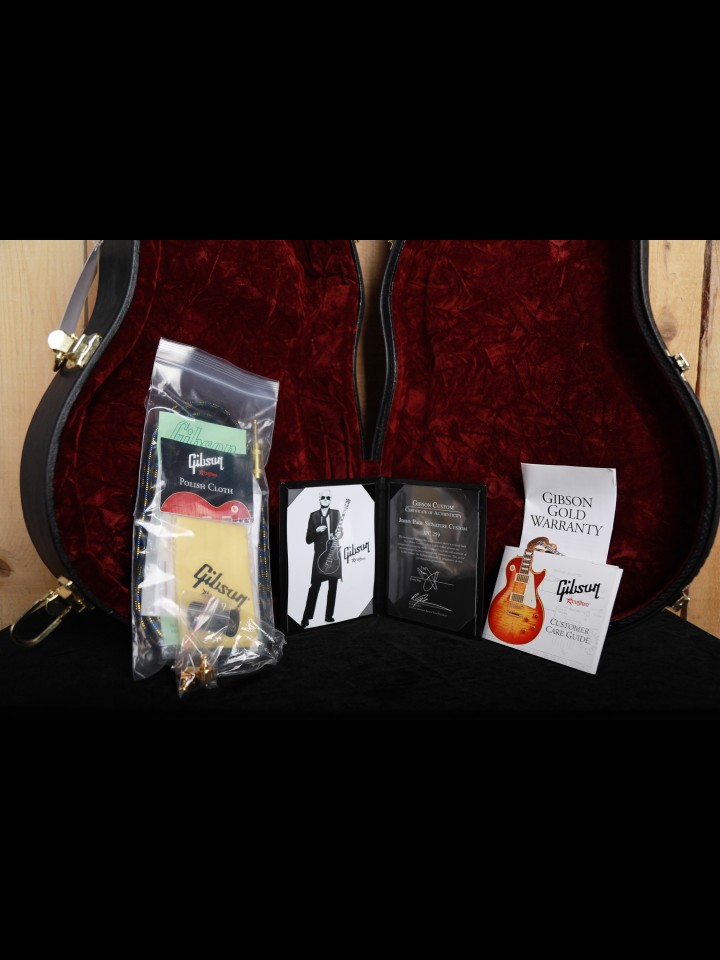
Though we do not typically deal in this sort of collectible artist model, we extremely excited by the recent arrival of this 2008 Jimmy Page 3-pickup Bigsby-equipped Custom, along with a 2009 “Pearly Gates” Les Paul VOS, which we are also representing. Of the 500 total Jimmy Page Custom models that Gibson produced in 2008, 475 were VOS (Vintage Original Spec), like this guitar, and 25 were signed by Jimmy Page. (In retrospect, it is ironic that this run of recreations was made before the original upon which they are based had actually been discovered and verified. As they are quite limited and seldom surface for sale, those examples signed by Jimmy Page obviously command a premium. While those of the VOS variety are relatively much more common than the signed version, number JPC259 here is an exceedingly rare time capsule find—frankly, we’ve never seen its equal. Not only is it in a remarkably-preserved, basically unused state, but it is accompanied by every bit of its original case candy, including the original shipping box. Simply put, as collectibles go, it doesn’t get any better than this, short of finding some mythic sealed, unshipped box hidden in a dark corner of Gibson’s factory (and, these days, that doesn’t happen!). As such, this gorgeous replica of one of rock history’s most famous and iconic guitars is an exceptionally rare opportunity for any serious Gibson collector or Led Zeppelin fan.
Condition
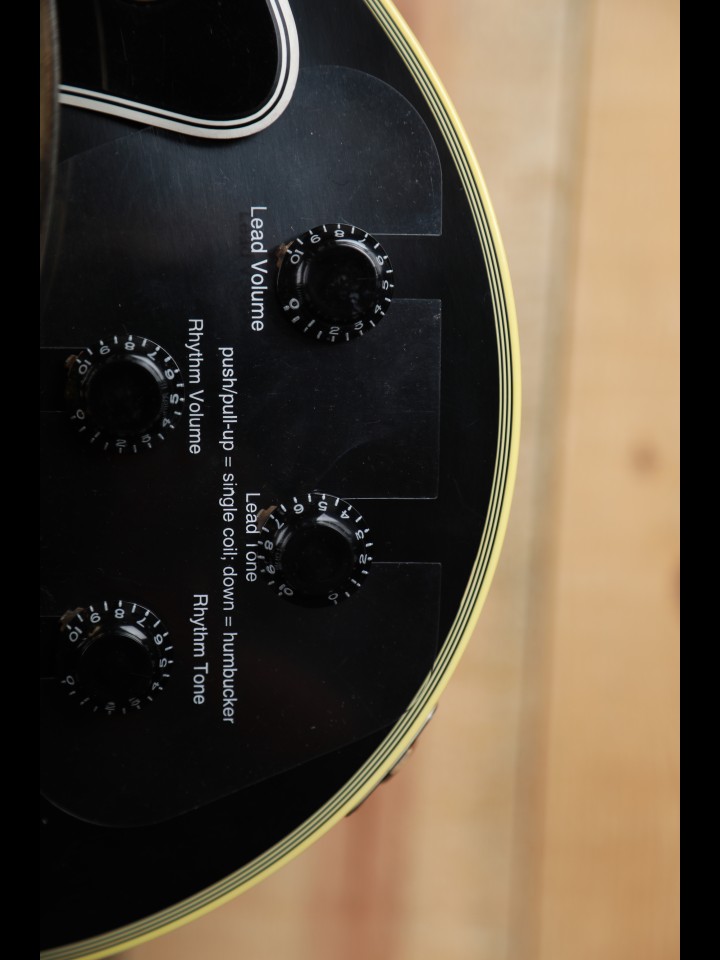
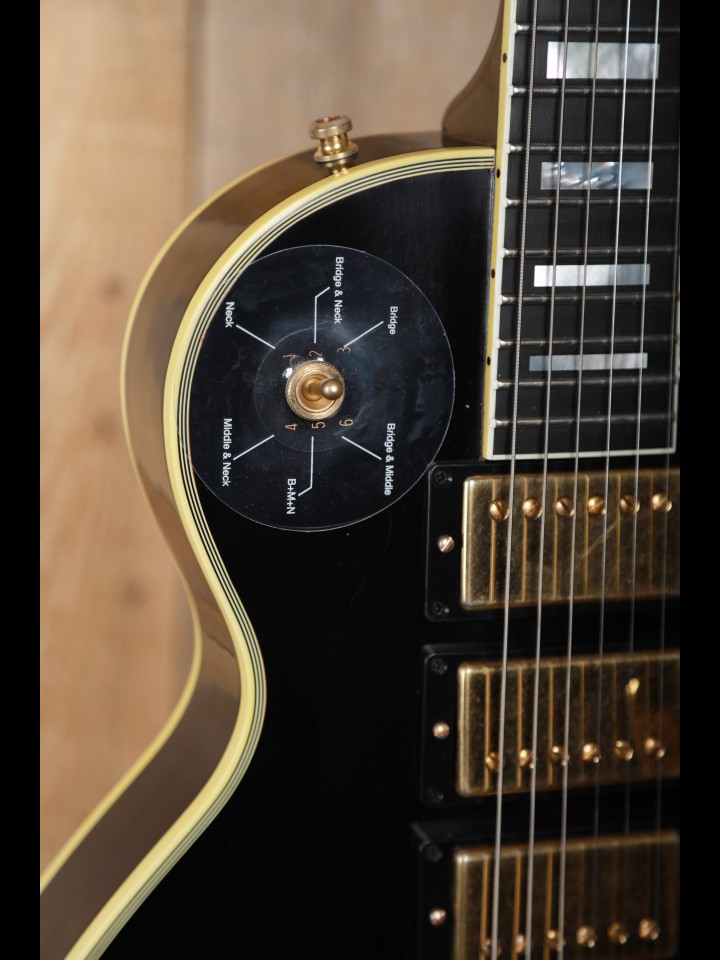
As stated above, this Jimmy Page Les Paul Custom VOS model appears to have effectively been stored in an unused state since it was originally unboxed and admired. That said, when the guitar arrived we did notice that the plastic overlay for the control knobs had been removed—this suggests that the guitar was perhaps played for at least some brief period by its original (and only) owner, who might have removed it to better utilize the controls. We have since reinstalled this plastic overlay to recreate the original look. Meanwhile, the plastic overlay on the toggle switch was still in place when the guitar arrived and shows no signs of every being removed or altered. This aside, this guitar is as clean as they come! On a related note, in light of this guitar’s ultra rare seemingly untouched state, we have elected to leave it in an as-is state. However, we did perform an electronics check, and all electronics are functioning properly. Otherwise, please note that we will only be performing our customary setup work and restringing at the behest of the next owner. EXCEPTIONALLY FINE Condition
- Single Cutaway Solid Body
- Carved Mahogany Top
- Mahogany Body
- VOS Ebony/Black Top and Body Finish
- Single-Ply Crème Top Binding with 6-Ply Purfling
- Single-Piece Mahogany Neck
- Ebony Fingerboard
- Crème Fingerboard Binding
- Mother of Pearl Block Fingerboard Inlays
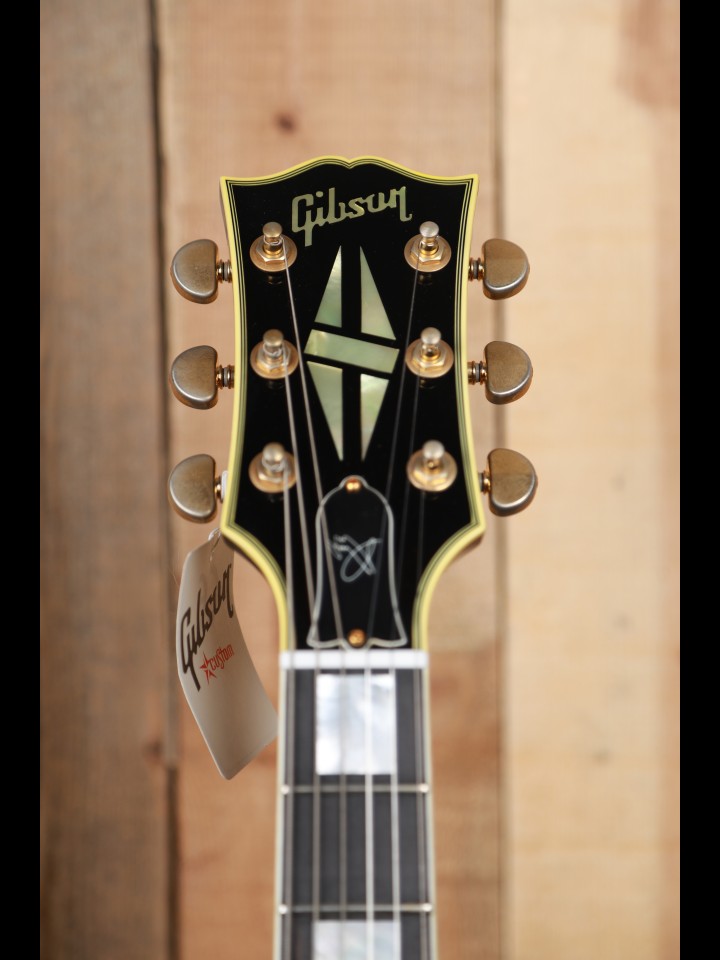
- Inlaid Mother of Pearl “Gibson" Peghead Logo with Split Diamond
- 4-Ply Headstock Binding
- Black Truss Rod Cover with Etched Jimmy Page Signature
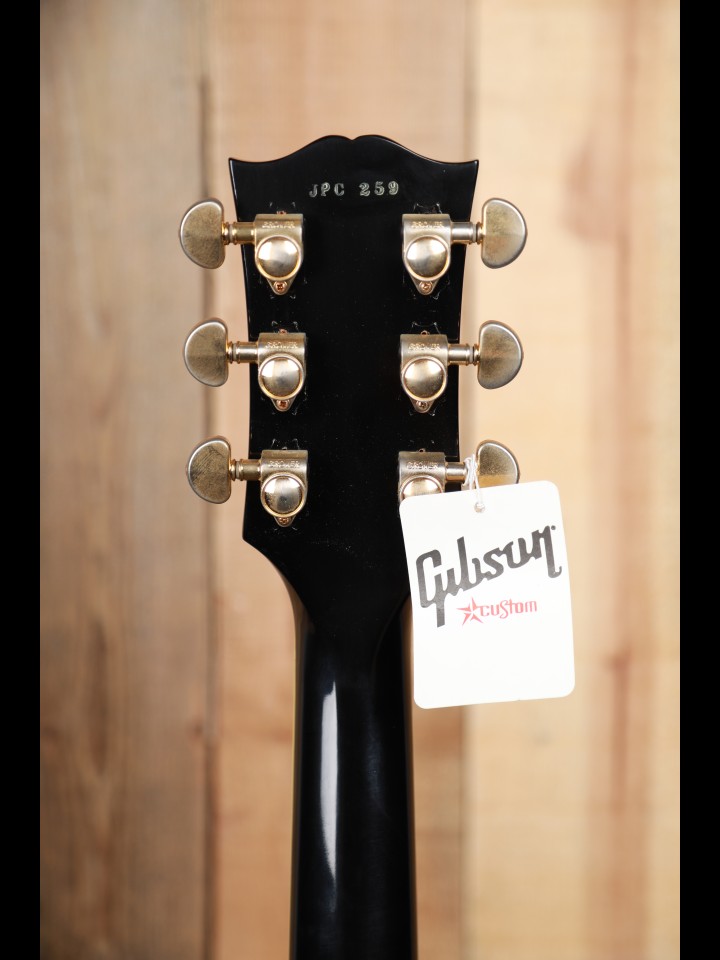
- Gold Grover Rotomatic Tuners with Replicated Exposed Mounting Holes (from Original Kluson)
- Three Jimmy Page Custom Burstbucker Humbucker Pickups with Gold Covers
- Two Master Volume and Two Master Tone Controls (Bridge Tone = Push/Pull Pickup Coil Tap)
- Black Bonnet Knobs
- 6-Way Pickup Selector
- Gold ABR-1 Tune-O-Matic Bridge
- Gold Bigsby B3 Vibrato
- 3-Ply Black Pickguard
- Black Jack Plate
- 1 11/16th” Nut Width
- 24 ¾” Scale Length
- 10.3 lbs
- Bone Nut
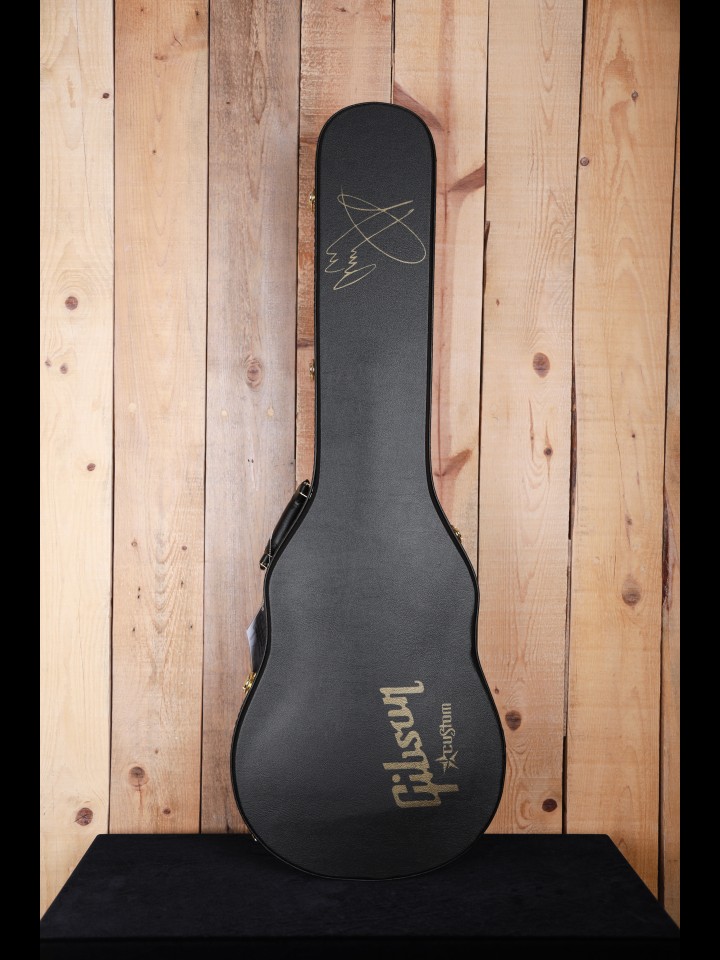
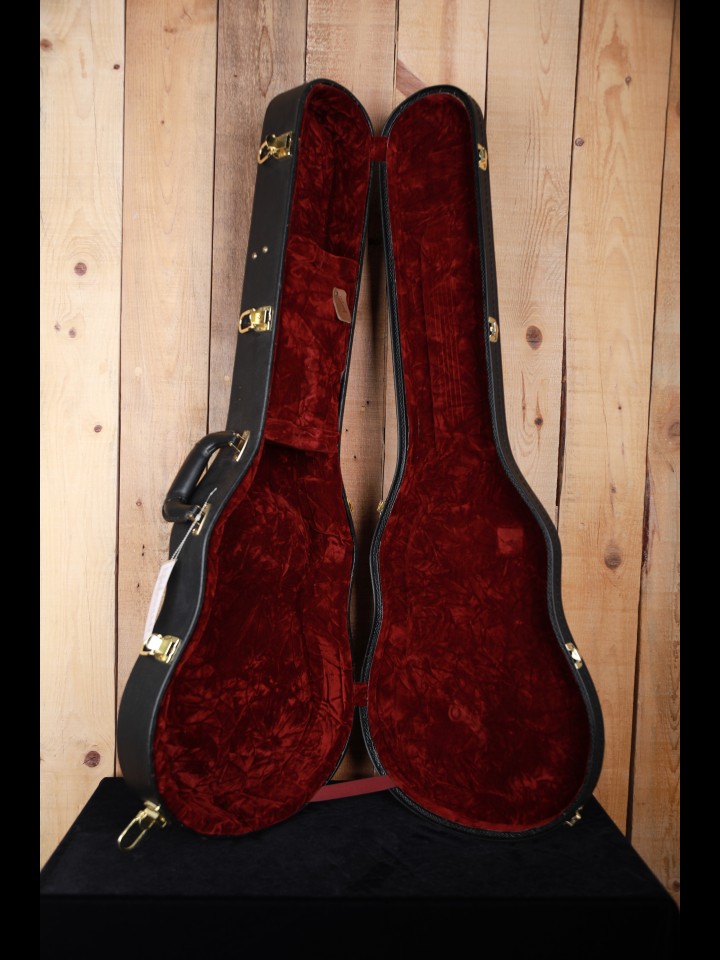
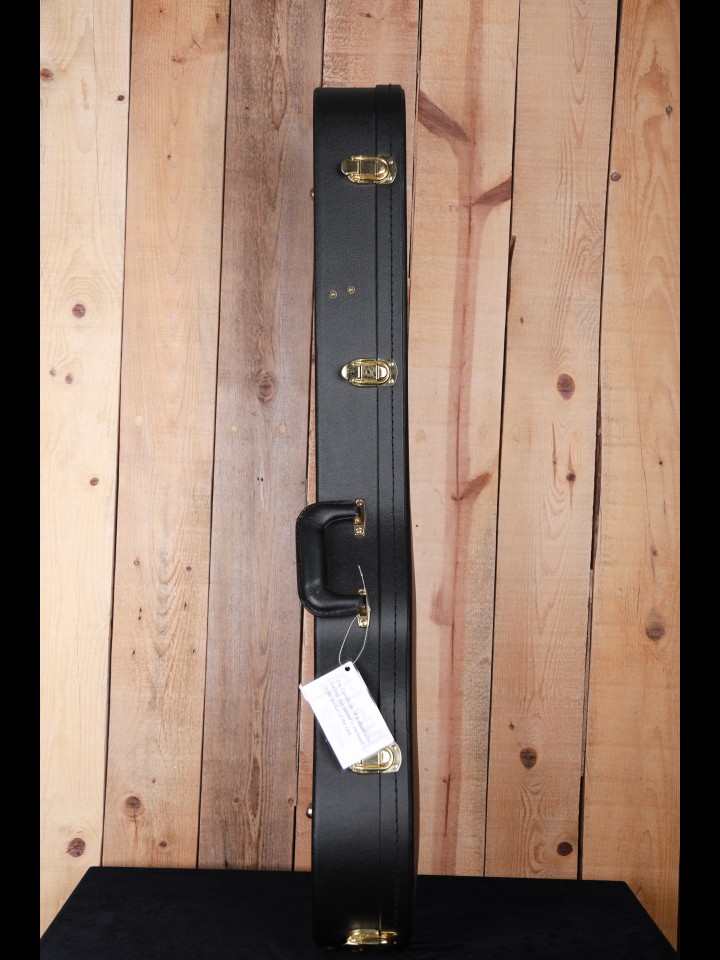
- Original Custom Shop Case (Black Exterior, Wine Interior)
| Brand | GIBSON |
| Model | CS LPBPAGE |
| Serial Number(s) | JPC259 |